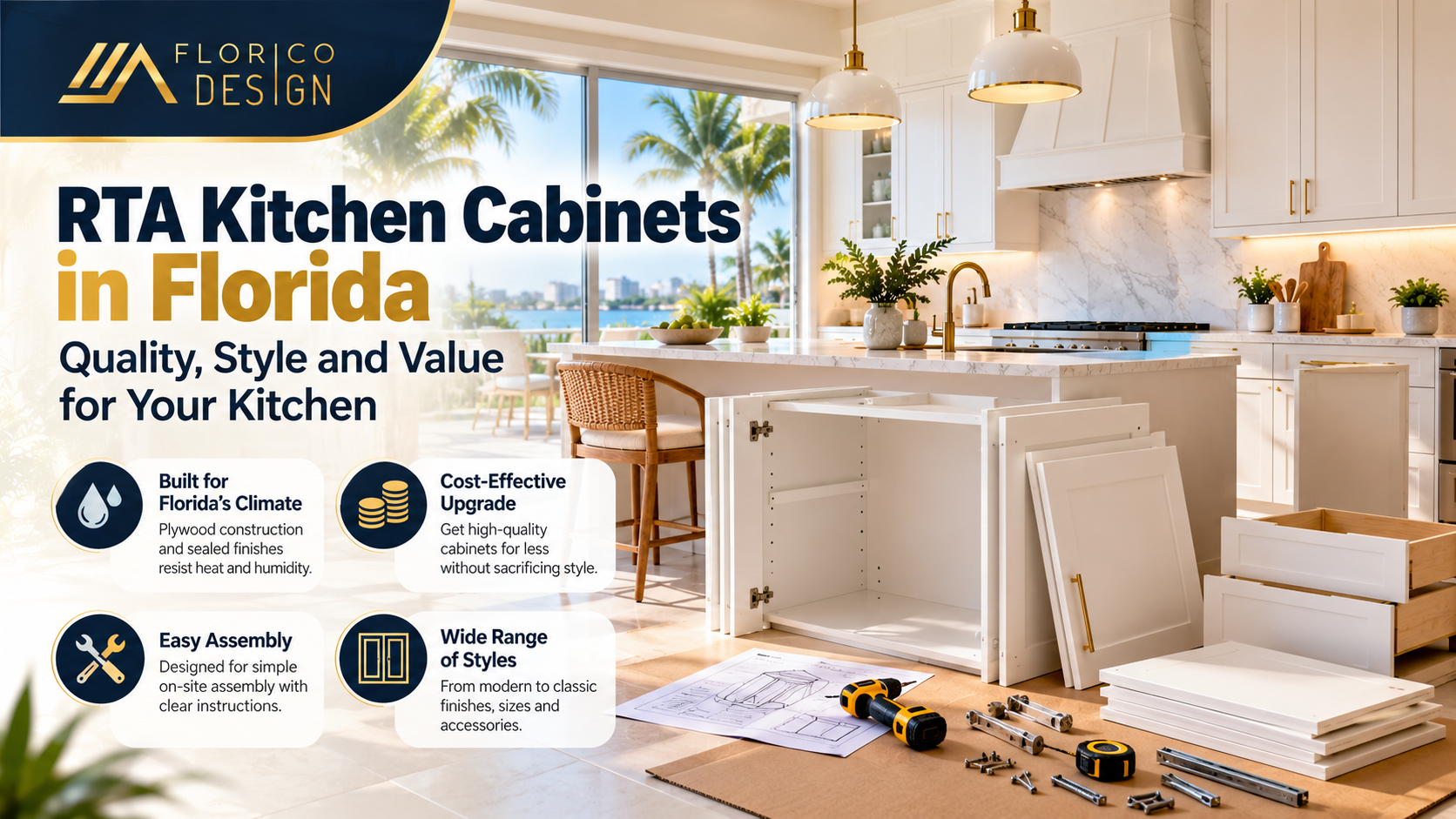
Oct 5, 2026 · Florico design
RTA Kitchen Cabinets in Florida- How Good Are They for Your Kitchen, Really?

Short answer: yes, RTA kitchen cabinets can be an excellent choice for a Florida kitchen, as long as you buy plywood boxes, fully sealed finishes, and hardware specified for humid, salty air. Ready-to-assemble describes how the cabinets ship, not how well they're built, and a good RTA line performs in heat and humidity as well as its pre-assembled equivalent while costing less. Below is the verdict in detail: construction, assembly, door styles, sizes, accessories, availability, and price. If you want to know what you're actually paying for before a finish wins you over, spend ten minutes on the products page comparing the construction specs of two or three lines side by side.
If you're pricing RTA kitchen cabinets in Florida, you've probably wondered whether flat-pack cabinets can handle our humidity, heat, and salt air. Some can't, and they fail fast. Others hold up just as well as cabinets that arrive fully built, at a lower price. The difference comes down to a few construction details, and they're easy to check before you buy.
The Short Answer: Yes, With Conditions:
Florida kitchens face two stresses milder climates don't: sustained high humidity and long stretches of heat, when indoor moisture climbs every time a door opens or the AC cycles. A well-specified RTA cabinet handles both as well as a pre-assembled one, because the box is the same box. Plywood construction, a finish sealed on all six sides, and hardware chosen for the environment carry the load, not whether the cabinet was screwed together in a factory or in your garage. A cheap particleboard box will swell and sag here whether it arrives flat-packed or fully built. The format isn't the variable; the construction details are.
What "RTA" Actually Means:
RTA stands for ready-to-assemble. Instead of arriving as finished, pre-built boxes, the cabinets ship flat in cartons, sides, backs, shelves, and doors, and go together on site with cam locks, dowels, screws, or interlocking joinery. Doors and drawer fronts are finished at the factory, so you're assembling parts cut to tight tolerances rather than building furniture. The savings come from freight and warehousing, not from thinner materials.
Assembly: What You're Signing Up For:
Assembly is the real tradeoff. Most lines are designed around basic tools, a screwdriver or drill, a rubber mallet, a square, and clear floor space, and the instructions are a matter of following a sequence rather than improvising. Even so, it's labor, and it has to be done squarely: a box built out of square will fight you at install time and show in the door gaps. If you'd rather not do it yourself, ask whether your installer will assemble on site and what that adds, then compare totals before deciding RTA is the cheaper route.
Why RTA Makes Sense in Florida:
Humidity Is the Real Test
Florida is humid year-round, and that's what separates good cabinets from disappointing ones. Moisture causes particleboard to swell, delaminate at the edges, and sag under the weight of dishes. Plywood, by contrast, is cross-laminated and resists warping while holding screws better over time.
If you take away one rule for a Florida kitchen, make it this: choose plywood boxes with a moisture-resistant finish, and skip bargain particleboard. Look for solid hardwood face frames and doors sealed on all six sides, including the back and the inside of the door panel, where cheap manufacturers often leave raw wood exposed. Upkeep helps too: wipe spills quickly, clean faces with a damp rather than wet cloth, and run the range hood so steam doesn't sit on finishes.
Shipping, Lead Times, and Availability:
Flat-packed cartons are less likely to arrive with dented corners or scuffed finishes than fully assembled boxes riding a truck through Florida traffic. They also fit through the narrow stairwells and elevators common in coastal condos, where an assembled pantry cabinet won't make the turn.
Ask about availability early. Common sizes in a popular line are often in stock for quick delivery, while special finishes, odd widths, or accessories such as roll-out trays may be made to order with longer lead times. Confirm what's in stock before you commit to an install date.
Coastal Hardware Considerations:
Salt air is hard on metal. Near the coast, ask about hinge and slide finishes and consider stainless or coated hardware for pulls and knobs. The box may last decades; hardware is what fails first if it isn't specified for the environment.
Shopping Smart: Styles, Overlays, Sizes, and Price:
Door Styles, Overlays, and Finishes
Shaker remains the default for good reason: the flat recessed panel is easy to clean, hides minor wear, and reads well in a coastal cottage or a modern condo. Overlay matters more than most shoppers expect: full overlay doors sit nearly flush with only a thin reveal between them, giving a tighter, more contemporary look down a long run, while partial overlay leaves more face frame exposed and reads more traditional. A photo gallery of completed kitchens is the easiest way to see that difference at full scale, a single door sample can't show you how a reveal reads across ten feet of cabinetry.
White is a perennial favorite in Florida kitchens, it bounces daylight around and keeps a small condo kitchen from feeling closed in. But white isn't one color. Some lines run cool and crisp, others warm toward cream, and the same door can read grey or yellow depending on the counter beside it and the time of day. Color names aren't standardized either, so a "grey" in one line won't match the same name in another. Order samples from the lines you're comparing and view them in your own kitchen, morning and evening, against your counter and flooring. Collection names like Camden are product names rather than universal style terms, so ask for the specifics behind the name: wood species, finish system, frame width, overlay type, and whether interiors are finished to match.
Height, Depth, and Standard Sizes:
Most of what you'll browse follows industry-standard dimensions. A regular base cabinet is about 34.5 inches tall and 24 inches deep, landing the countertop near 36 inches. Wall cabinets are typically 12 inches deep in 30-, 36-, or 42-inch heights, with the taller options closing the gap to the ceiling, worth considering in a humid climate, since an open soffit gap collects dust and grease.
Accessories and Inserts:
Roll-out trays, pull-out trash bins, drawer dividers, and tray dividers are far easier to order with the cabinets than to retrofit later. Check which accessories fit which box widths, and whether they arrive factory-installed or as one more assembly step.
Price, Sales, and What's Actually Included:
RTA pricing is usually quoted per cabinet or per linear foot, and a starting price rarely describes the kitchen you'll actually order, it generally assumes the most basic box, standard sizes, and no upgrades. Before checkout, read each listing closely and verify what it includes: soft-close hardware, plywood versus particleboard sides, finished ends, toe kick, and filler strips. Then ask what's billed separately and what, if anything, is free: suppliers treat door samples, delivery, quotes, and design assistance differently, and it's worth confirming rather than assuming. Ask too whether special-order items can be returned or exchanged. Warranty and return terms say a lot about the business standing behind the boxes. A sale can be a genuine opportunity, but compare construction specs first and price second.
Conclusion:
RTA cabinets perform as well as pre-assembled ones in Florida's heat and humidity, what matters is the specification: plywood boxes, finishes sealed on all six sides, and corrosion-resistant hardware, compared spec by spec before price.