Sep 28, 2026 · Florico Design
Luxury Kitchen Remodeling in Miami and Boca Raton: Your Complete 2026 Renovation Timeline

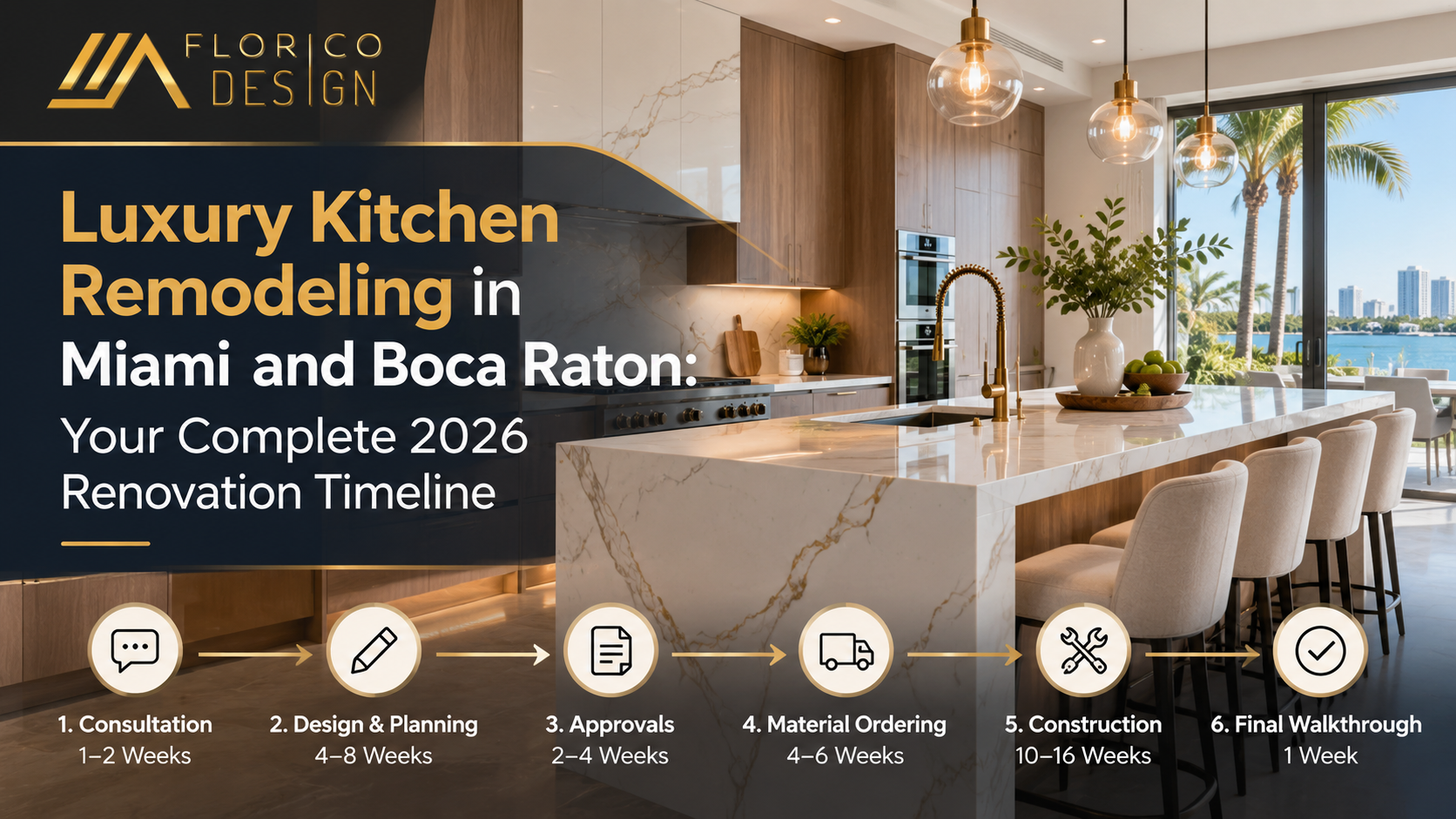
A luxury kitchen remodel in Miami or Boca Raton takes roughly six to nine months from first consultation to final walkthrough, typically three to four months of design, documentation, and approvals, plus 10 to 16 weeks of construction once materials land. Luxury kitchen remodeling in Miami rarely fails because of taste; it fails because of timing. Between HOA approvals, Miami-Dade and Palm Beach County permitting, and imported stone or custom cabinets with long lead times, the calendar drives everything. Before you fall in love with a slab, it helps to see how finished spaces come together; browsing our projects makes the sequence tangible, and if you already have a move-in date in mind, the lowest-friction next step is to send us that date so we can map the phases backward from it. Below is the full 2026 timeline, phase by phase, built around how real Miami and Boca Raton kitchens get designed, approved, ordered, and installed.
The Short Answer: Six to Nine Months
Plan on **six to nine months** from your first meeting to the final walkthrough on a true luxury kitchen in Miami or Boca Raton. That generally breaks down into three to four months of discovery, design, documentation, pricing, and approvals, followed by 10 to 16 weeks of active construction once materials are on site. The tier you choose drives most of that spread: an in-stock or semi-custom tier with no layout changes and light permitting can compress, while a full-gut remodel with custom European cabinets and imported stone sits at the long end.
Why South Florida Timelines Are Different
A kitchen renovation in Coral Gables, Miami Beach, or east Boca Raton is not the same project as one in a landlocked suburb. Coastal building codes, impact-rated openings, high-rise condo association rules, hurricane season work restrictions, and a seasonal contractor crunch between January and April all compress the window when trades are actually available. A full-gut remodel that relocates plumbing, gas, or structure adds review time on top of that.
That's why experienced designers treat scheduling as a design discipline, not an afterthought: define constraints first, then design within them.
Phase 1: Discovery and Programming (Weeks 1–3)
The first three weeks are about information, not finishes. A designer documents how you actually cook, entertain, store, and move, mapping the user journey before anyone picks a handle.
Deliverables in this phase typically include:
- Existing conditions measurements and photo survey
- Appliance wish list and utility requirements
- Budget range, phasing options, and priority ranking
- HOA or condo documentation review
Think of your kitchen as a physical interface. Where your hand lands when you open the refrigerator, how far the trash pull is from the prep sink, whether the coffee zone blocks the range — these are usability questions expressed in millwork. If an adjacent powder room or primary bathroom is part of the same remodeling scope, flag it now: shared trades and one permit cycle mean one disruption window instead of two.
Phase 2: Concept and Schematic Design (Weeks 3–8)
Now the visual work begins. Concept boards, layout options, and material direction get assembled, with mood boards, elevation studies, and annotated plans keeping dozens of decisions legible. Renderings and 3D walkthroughs shorten revision cycles, but they don't replace trained judgment about proportion, light, and durability in a humid coastal climate.
This is also where aesthetic direction starts affecting the schedule. Modern, handle-less slab-front cabinetry reads as simple but leaves almost no margin for error: reveals, panel alignment, and integrated appliance fronts have to be resolved on paper before anything is fabricated. Expect two to three rounds of revisions, roughly one week of production plus a few days of client review each. Slow client feedback is the most common cause of slippage in this phase.
Selecting Materials That Survive South Florida
Salt air, UV exposure, and year-round humidity narrow the field fast. Porcelain slabs, quartzite, marine-grade plywood cabinet boxes, stainless hardware, and moisture-stable veneers are essentials in beach-adjacent homes — not upgrades. Reviewing available finish and fixture products early lets your designer lock specifications before pricing is finalized, which prevents costly substitutions later.
## Phase 3: Documentation, Pricing, and Permitting (Weeks 8–16)
Construction documents, shop drawings, and engineering (if walls, gas lines, or structural elements move) go out for bid and permit simultaneously where possible.
Realistic 2026 expectations:
- **Condo/HOA architectural review:** 2–6 weeks, sometimes longer with a single monthly board meeting
- **Municipal permit review:** 4–10 weeks depending on jurisdiction and scope — Miami-Dade, Palm Beach County, and individual cities each run their own queues
- **Contractor pricing and value engineering:** 2–4 weeks
Nothing gets ordered until pricing is approved. Build that dependency into your plan.
## Phase 4: Procurement and Lead Times (Weeks 12–28, overlapping)
This is where 2026 projects live or die. Cabinets are usually the long pole in the tent. Typical ranges:
- Custom European cabinets: 14–24 weeks
- Domestic semi-custom cabinets: 8–14 weeks
- Natural stone slabs (in-stock local): 2–4 weeks
- Imported specialty stone: 8–16 weeks
- Luxury appliance packages: 6–20 weeks, with integrated, panel-ready refrigeration and dishwashers often at the longer end
- Plumbing fixtures and decorative hardware: 4–12 weeks
A good plan stays responsive: alternates pre-approved, so if a slab sells or an appliance slips, the schedule adapts instead of stopping. Order everything before demolition. Storing materials generally costs far less than an idle crew.
Phase 5: Construction (Weeks 20–36)
Once demolition starts, the sequence is fairly predictable:
1. Demolition and protection — 3–5 days
2. Rough mechanical, electrical, plumbing — 1–2 weeks
3. Inspections: 1–2 weeks (scheduling dependent)
4. Drywall, flooring, and paint prep — 2 weeks
5. Cabinet installation — 1–2 weeks
6. Template, fabrication, and stone installation — 2–3 weeks
7. Backsplash, appliances, plumbing trim, lighting — 1–2 weeks
8. Punch list and final inspection — 1–2 weeks
Total active construction for a high-end kitchen: **10 to 16 weeks**, assuming materials are on site and inspections are scheduled without delay.
Putting the Range in Context:
The six-to-nine-month range holds because phases overlap only partially: procurement can start once pricing is approved, but construction cannot start until long-lead items arrive. Faster timelines are possible at a more stock-oriented tier with minimal permitting, though they usually trade away customization. If you want to start cooking by Thanksgiving 2026, begin design work no later than February or March.
How to Protect Your Schedule:
- **Decide in batches.** Group approvals so production never idles.
- **Front-load approvals.** Submit HOA packages the week documents are complete.
- **Avoid mid-project layout changes.** A wall moved late in construction can add weeks.
- **Assign one decision-maker.** Committees tend to slow renovations as much as supply chains do.
- **Keep a 10–15% contingency.** Behind-the-wall surprises are common in older coastal homes.
Choosing the Right Team:
Look for a studio that handles full-service interior design end to end, space planning, specification, procurement tracking, and construction coordination in one integrated process, so kitchens and bathrooms in the same scope move on one schedule.
Conclusion:
A luxury kitchen remodel in Miami or Boca Raton typically takes six to nine months, about three to four months of design, documentation, pricing, and approvals, plus 10 to 16 weeks of construction once materials arrive.
For more details and questions book a free consultation with us now.