Sep 14, 2026 · Florico Design
21 Premium Kitchen Cabinets for Parkland Homeowners: From Shaker to Custom and RTA to Semi-Custom
Introduction
Picking kitchen cabinets in Parkland isn't the same exercise as in Ohio or Colorado. The materials that hold up fine in a dry climate can swell, gap, or peel within a few years here, and the sheer number of door styles, finishes, and construction tiers on the market makes it easy to fall in love with a look before checking whether it will actually survive South Florida's humidity.
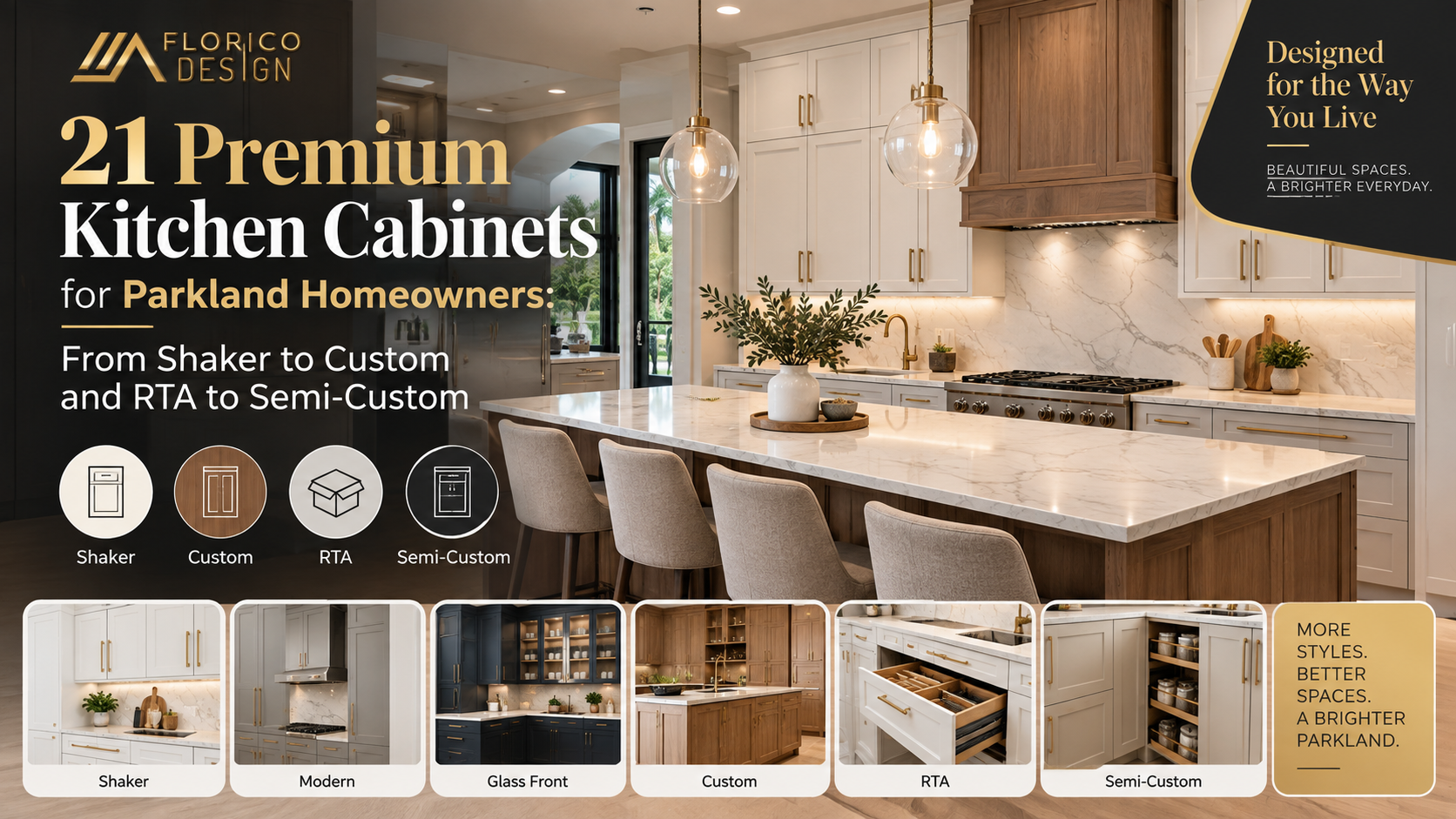
This guide walks through 21 cabinet styles worth considering, organized by the four construction tiers you'll run into while shopping: stock, RTA (ready-to-assemble), semi-custom, and full Custom. You'll see how shaker, slab, and raised-panel doors show up across each tier, what changes in quality and price as you move up, and which combinations tend to work best for Parkland kitchens specifically. By the end, you should be able to walk into a showroom and know exactly which questions to ask.
Why Cabinet Choice Matters More in Parkland
Parkland sits inland from the coast but still deals with the same year-round humidity that defines South Florida, with relative humidity often sitting in the 70 to 80 percent range for much of the year. Over time, that moisture works its way into particleboard cabinet boxes, causing swelling at the seams, delamination along exposed edges, and warped shelves that never quite close right again after the first rainy season.
This is why cabinet construction matters as much as the door style you pick. A gorgeous shaker door on a weak particleboard box will not perform the same way here as it does in a showroom photo taken in a climate-controlled studio somewhere up north. Solid, all-plywood box construction is the detail worth asking about before anything else, regardless of which of the 21 styles below catches your eye.
Understanding the Four Cabinet Construction Tiers
Before getting into individual styles, it helps to understand the four tiers that every cabinet on this list falls into. These tiers describe how the cabinet is built and how much you can customize it, not just what the door looks like.
Stock cabinets come in fixed, factory-set sizes with limited finish choices. They're the fastest option to get and the least flexible.
RTA cabinets (ready-to-assemble) ship flat-packed and are assembled on-site or in a shop before installation. Quality varies enormously here: some RTA lines use the same all-plywood, dovetail-drawer construction as higher tiers, while others cut corners with particleboard and stapled joints. The construction quality matters more than the RTA label itself.
Semi-custom cabinets start from a standard cabinet box but allow modifications to width, height, depth, and finish, along with a wider range of storage inserts and hardware. This tier covers most mid-range kitchen remodels.
Full Custom cabinets are built to your kitchen's exact dimensions from scratch, with no size constraints and the broadest range of wood species, finishes, and configurations. This tier costs the most and takes the longest to build, but it's the only option for unusual layouts, non-standard ceiling heights, or highly specific storage needs.
21 Cabinet Styles Worth Considering
Here are 21 cabinet door styles and configurations homeowners in Parkland are asking about right now, grouped by the look they deliver.
Shaker and Transitional Styles
- Classic Shaker White – The five-piece flat-panel door with a recessed center remains the most requested style in Florida kitchens because it works in traditional, transitional, and modern spaces alike.
- Shaker Gray – A warmer alternative to stark white that pairs well with quartz countertops and brushed nickel or matte black hardware.
- Slim Shaker – A narrower rail width than classic shaker, giving a leaner, more contemporary silhouette while keeping the recognizable shaker profile.
- Two-Tone Shaker – Upper cabinets in white or a light neutral with a contrasting island or lower-cabinet color, a layout that continues to dominate open-concept kitchens.
- Shaker with Glass-Front Uppers – Combines the classic frame with glass inserts on select upper cabinets to break up a wall of solid doors and display dishware.
Modern and Slab-Front Styles
- Flat-Panel Slab – A completely flat door front with no raised or recessed detail, currently the fastest-growing style category among kitchen designers nationally.
- High-Gloss Slab – A slab door finished in a high-gloss lacquer, popular in contemporary Parkland builds that lean into a sleek, reflective look.
- Matte Slab in Deep Tones – Charcoal, forest green, and navy slab cabinets have become a common way to add contrast without going fully dark on every wall.
- Wood-Grain Slab – A slab profile finished in a natural or rift-oak wood grain rather than a painted color, bringing warmth to an otherwise minimalist layout.
- Handleless Slab with Integrated Pulls – A slab door milled with a finger-pull channel instead of hardware, giving a cleaner line along the cabinet run.
Classic and Raised-Panel Styles
- Raised-Panel Traditional – A more ornate door profile with a beveled, raised center panel, still common in larger, more formal Parkland homes.
- Cathedral Arch Panel – A raised-panel variation with an arched top rail, a style that reads as more classic or Mediterranean in feel.
- Beadboard Panel – Adds vertical groove detailing to the door face, often used on an island to separate it from the rest of the kitchen visually.
- Inset Cabinetry – Doors sit flush within the face frame rather than overlaying it, a higher-end detail that requires tighter tolerances and more precise installation.
- Glazed and Distressed Finishes – A traditional panel door finished with a glaze in the recesses to create an aged, hand-finished appearance.
Specialty and Storage-Focused Configurations
- Furniture-Style Island Cabinetry – Cabinets designed to look like a freestanding furniture piece, often with turned legs or a contrasting wood tone, used specifically for kitchen islands.
- Open Shelving Combined with Cabinetry – A mix of closed cabinet runs and open shelving sections, useful for display and for lightening a heavy cabinet wall visually.
- Appliance Garage Cabinets – A cabinet configuration built to conceal small countertop appliances behind a tambour or lift-up door, keeping counters clear.
- Pull-Out Pantry Cabinets – A tall, narrow cabinet fitted with sliding shelves, useful in kitchens without room for a full walk-in pantry.
- Corner Cabinets with Lazy Susan or Blind-Corner Pull-Outs – Specialty hardware inside a standard cabinet box that makes awkward corner space usable.
- Two-Toned Base with Waterfall Island Panel – A base cabinet finish that continues down the side of an island to meet a waterfall countertop edge, a detail that has become common in higher-end Parkland kitchen remodels.
Construction Tiers Compared at a Glance
Tier
Customization
Typical Lead Time
Best For
Stock Fixed sizes, limited finishes Fastest, often in-stock or short order Quick updates, rental properties, tight budgets
RTA Fixed sizes, moderate finish range, self- or pro-assembled Short to moderate Budget-conscious remodels where construction quality is verified upfront
Semi-Custom Modified sizes, wide finish and hardware range Moderate Most standard kitchen layouts and mid-range remodels
Full Custom Built to exact specifications Longest Unusual layouts, specific storage needs, high-end finishes
Within any of these tiers, always confirm the box material. All-plywood construction with dovetail drawer boxes and soft-close hardware tends to outlast particleboard equivalents by a wide margin. That gap shows up faster in Florida's humidity than in drier states.
What Actually Drives Cabinet Pricing
Rather than quoting numbers that shift by supplier, season, and material availability, it's more useful to understand the factors that actually move your quote up or down:
- Box material. Plywood costs more than particleboard but resists humidity-related swelling far better over the life of the kitchen.
- Door style complexity. A flat slab door is simpler and generally less expensive to produce than a raised-panel or inset door with tighter tolerances.
- Finish type. Painted finishes, high-gloss lacquers, and hand-glazed treatments each carry different labor costs.
- Hardware and storage inserts. Soft-close hinges, full-extension drawer glides, pull-out shelving, and specialty corner hardware all add to the total.
- Kitchen layout. Extra corners, islands, and non-standard wall dimensions increase the number of Custom or modified pieces needed.
- Installation complexity. Older Parkland homes with uneven walls or non-standard ceiling heights sometimes require additional on-site adjustments.
For an accurate number for your specific kitchen, the only reliable option is a measured, in-home or in-showroom consultation, since online calculators can't account for your layout or the condition of your existing space.
Choosing the Right Fit for Your Kitchen
A few practical questions can narrow the list of 21 styles down quickly:
Are you renovating on a tight timeline, like before a home sale? Stock or a well-built RTA line will move fastest.
Do you have a standard rectangular kitchen with typical ceiling heights? Semi-custom usually covers everything you need without the full-custom flexibility you won't use.
Do you have an unusual layout, a large island, or specific storage requests, like an appliance garage or a furniture-style island? Full Custom is worth the extra time and cost.
Is resale value a factor? Shaker and slab styles in neutral tones tend to have the broadest buyer appeal in the Parkland and greater Miami market. At the same time, highly specific finishes like glazed or distressed cabinetry can narrow your future buyer pool.
Whichever direction you lean, ask to see the box construction in person, not just the door sample. A showroom will always show its best door finish; the box behind it is where the real difference between a five-year kitchen and a twenty-year kitchen shows up.
Final Thoughts:
Twenty-one styles is a lot of ground to cover. Still, the decision usually comes down to two questions: which look fits your kitchen and your taste, and which construction tier and box material will actually hold up in a Parkland home. Shaker and slab doors will keep showing up as the front-runners for good reason, but the door style is only half the decision. The box behind it, and whether it's built from plywood or a weaker composite, is what determines whether your kitchen still looks and functions the same way a decade from now.
If you're weighing shaker against slab, or trying to decide whether semi-custom covers your layout or you actually need full Custom, browsing Florico Design's full cabinet door style catalog is a good next step, since you can compare finishes like Shaker White, Luna Dove, and Galaxy Horizon side by side. For a deeper look at how Custom and semi-custom pricing compares specifically in Parkland, see our guide on Custom vs. semi-custom kitchen cabinets in Parkland.
FAQs:
What is the most popular kitchen cabinet style in Florida right now?
Shaker in its classic and slim variations remains the most requested style because it works across traditional, transitional, and modern kitchens without looking dated in five years.
Are RTA cabinets a bad idea in a humid climate like Parkland's?
Not inherently. The issue is construction quality, not the RTA format itself. Look for all-plywood boxes and dovetail drawer construction rather than assuming every RTA option is lower quality.
What's the real difference between semi-custom and full Custom cabinets?
Semi-custom modifies a standard cabinet box in width, height, depth, and finish. Full Custom builds every piece to your kitchen's exact measurements with no size constraints, which matters most for unusual layouts or non-standard ceiling heights.
How long does a Custom kitchen cabinet order typically take?
Custom cabinetry generally takes the longest of the four tiers because every piece is built to order. At the same time, stock and RTA options are typically available faster since they use pre-set sizes.
Does cabinet box material really matter that much in South Florida?
Yes. Plywood resists the swelling and delamination that particleboard is prone to in high-humidity conditions, which matters more for cabinet longevity here than in a drier climate.
Can I mix cabinet styles in the same kitchen, such as shaker uppers with slab lowers? Yes, and it's an increasingly common way to add visual interest, particularly with a two-tone layout that uses one style and color on the island and another on the perimeter.
Ready to see these cabinet styles in person? Schedule a free kitchen design consultation with Florico Design at our Coconut Creek showroom, and our team will help you match the right construction tier, door style, and finish to your Parkland kitchen and budget.