Sep 17, 2026 · Florico Design
Custom Closet Materials Guide: What Actually Holds Up in South Florida Humidity

South Florida's humidity is hard on custom closets, and the material behind the doors matters more here than almost anywhere else in the country. Solid plywood holds up best over time, melamine works fine if the edges are properly sealed, and unsealed MDF or basic wire shelving tend to warp or sag faster in this climate. Hardware like soft-close hinges, full-extension glides, and quality edge banding matters just as much as the material itself. This guide breaks down how each option performs in Florida humidity, what to ask a closet designer before you commit, and what actually drives your quote up or down.
Comparing custom closet materials for your Florida home? See how plywood, melamine, MDF and wire perform in humidity, plus what to ask before you buy.
Introduction:
Most homeowners shopping for a custom closet spend their time comparing layouts, finishes, and accessories, and almost no time on the one decision that determines whether the system still looks good in ten years: what it's actually built from. That's a bigger mistake in Parkland, Boca Raton, or anywhere else in South Florida than it would be in a drier climate, because the materials that perform fine in Ohio or Arizona can warp, swell, or delaminate here within a few humid seasons.
This guide breaks down how plywood, melamine, MDF, and wire shelving each perform under South Florida's humidity, what to ask a closet designer before you sign off on a material, and which hardware details are worth paying attention to regardless of which material you choose. If you've already looked at closet pricing or closet styles, this fills in the piece those guides don't cover in depth: what's actually inside the box.
The Closet Problem Most Florida Homeowners Don't See Coming
Wire shelving is still the default in a lot of South Florida homes because it's inexpensive and easy to install during original construction. The trouble shows up later: wire shelving sags under the weight of folded sweaters or stacked linens, it doesn't support drawers or hampers well, and it does very little to organize a closet beyond hanging rods and a shelf or two.
Homeowners upgrading from wire shelving to a built system are often surprised by how many material options they suddenly have to choose between, and by how differently those materials behave once real Florida humidity gets involved over a few years, not just on installation day when everything looks the same.
Why Humidity Changes the Material Conversation
South Florida's relative humidity commonly sits in the 70 to 80 percent range for much of the year, with swings that are more dramatic during summer storm season. That moisture works into unsealed edges and lower-grade composite materials over time, which is why a closet system that looks identical to another one in a showroom can perform very differently five years into ownership.
The core issue is moisture absorption. Materials that absorb humidity tend to swell, and swelling leads to warped shelves, doors that stop closing flush, and drawer boxes that bind or separate at the seams. Materials that resist moisture absorption, or that are properly sealed against it, hold their shape and keep functioning the way they did on day one.
Comparing Custom Closet Materials With Solid Plywood:
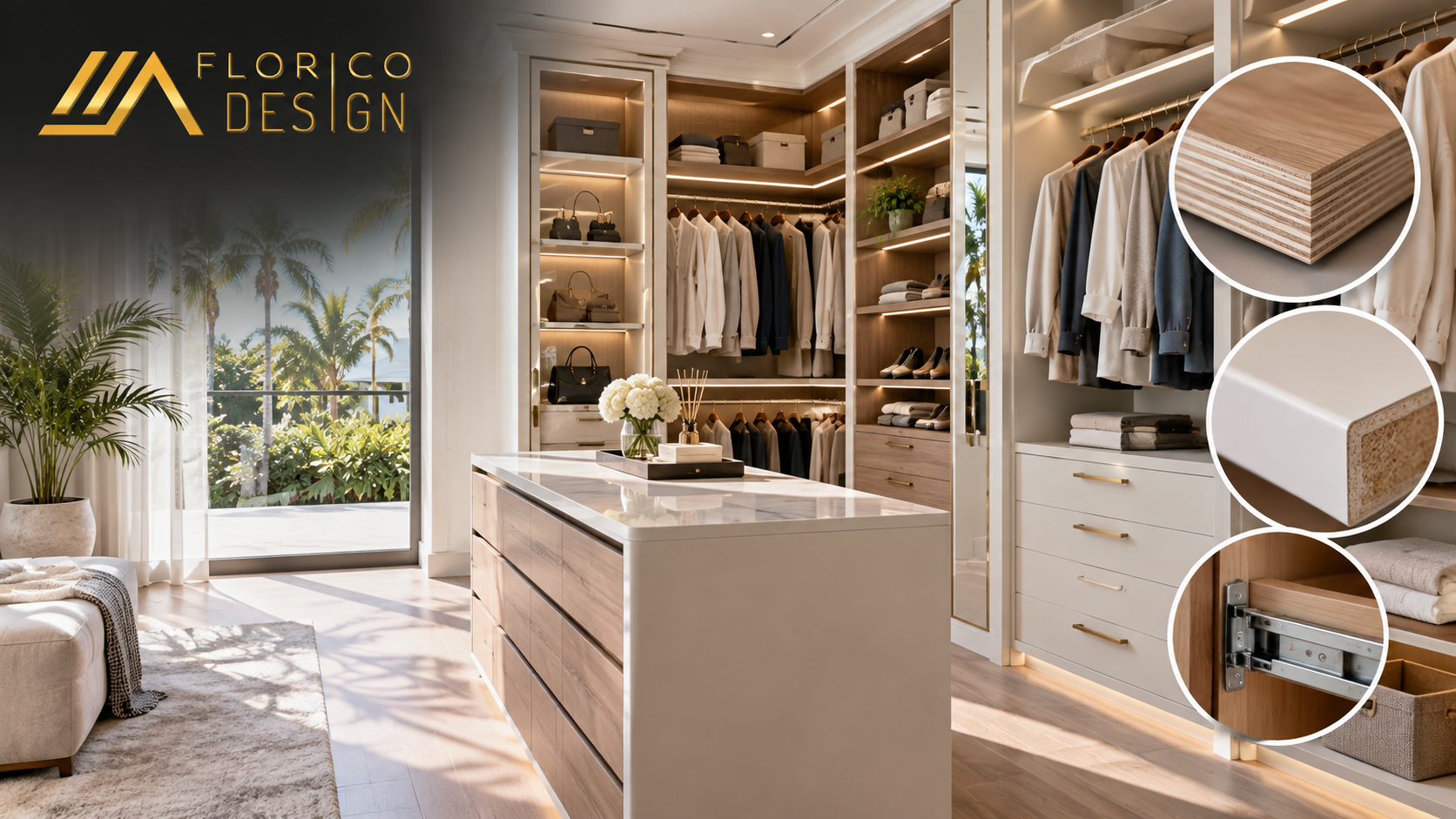
Plywood is made from layered wood veneers glued with the grain running in alternating directions, which gives it strong dimensional stability. It resists warping and holds screws and hardware more securely than composite materials, which matters over years of opening and closing doors and drawers. Plywood is generally considered the strongest choice for humid climates and is the material most associated with cabinetry built to last two decades or more.
The tradeoff is cost. Plywood systems typically carry a higher price than melamine or MDF equivalents, and not every closet company builds with it as a standard.
Melamine-Coated Board
Melamine is a particleboard or engineered wood core with a hard, resin-based laminate bonded to the surface. That laminate coating acts as a barrier, which is why melamine holds up reasonably well in humidity as long as the core material underneath isn't exposed. The vulnerability is at the edges and any cut or drilled point where the core is exposed to air; if those aren't properly edge-banded and sealed, moisture can work into the core over time and cause swelling from the inside out.
Melamine is generally more affordable than plywood and available in a wide range of colors and finishes, which is part of why it's a common choice for closet systems priced for the broader market.
MDF (Medium-Density Fiberboard):
MDF is a dense, uniform composite made from wood fibers bonded under heat and pressure. It takes paint finishes very smoothly, which makes it popular for painted closet doors and face panels. However, MDF is more porous than plywood and absorbs moisture readily if it isn't fully sealed, which makes it one of the more humidity-sensitive materials on this list when used for structural components rather than just door faces.
Wire Shelving:
Wire shelving is the least expensive option and the fastest to install, which is why it shows up as a builder-grade default. It doesn't organize much beyond hanging space and open shelving, it sags under sustained weight, and it offers no support for drawers, hampers, or shoe storage systems. It also does very little to protect stored items from South Florida's humidity swings, since there's no enclosed storage at all.
Solid Hardwood:
Solid hardwood is the most premium option and is often reserved for accent pieces, islands, or furniture-style elements rather than an entire closet system, largely due to cost and the natural expansion and contraction wood undergoes with humidity changes. Properly finished and sealed, it performs well, but it requires more careful construction to account for that natural movement than an engineered material does.
Materials Compared at a Glance:
Material
Humidity Resistance
Typical Cost Tier
Best Use in a Closet System
Solid Plywood
Excellent when properly finished
Higher
Full box construction meant to last decades
Melamine
Good, if edges are sealed
Mid-range
Budget-conscious systems with wide color options
MDF
Fair to poor if unsealed
Mid-range
Painted door faces and trim, not structural boxes
Wire Shelving
Poor organization value, no enclosed protection
Lowest
Basic hanging space, not a full storage solution
Solid Hardwood
Good with proper finishing, moves with humidity
Highest
Accent pieces and furniture-style details
Hardware and Accessories That Matter as Much as the Material:
Even the best material choice underperforms if it's paired with poor hardware. A few details worth asking about during a design consultation:
Soft-close hinges and drawer glides. These reduce wear on the material over thousands of open-and-close cycles and prevent the slamming that loosens joints over time.
Full-extension drawer glides. These allow drawers to open completely, which matters more in a closet than a kitchen since you're often looking for a specific folded item.
Adjustable shelving. Fixed shelf heights rarely match how storage needs change over a few years, so adjustable shelf pins or track systems add long-term flexibility.
Edge banding quality. Since edges are the most vulnerable point for moisture intrusion on melamine and MDF, ask specifically how edges are sealed and finished.
Ventilated versus solid shelving. Ventilated shelf sections can help with airflow in enclosed closets, which is a small but meaningful detail in a humid climate.
What Influences Custom Closet Pricing
Rather than quoting specific numbers that shift by material availability, closet size, and accessory selection, here's what actually drives your quote up or down:
Material choice. Plywood costs more than melamine or MDF, but often costs less over the life of the closet if it avoids replacement or repair.
Closet size and configuration. A reach-in closet with a single wall of storage costs less than a walk-in with an island, built-in seating, or a dressing area.
Accessory selection. Pull-out hampers, jewelry drawers, shoe fences, valet rods, and specialty hardware all add to the total.
Finish and door style. A painted finish, a wood-grain laminate, or a glass-front cabinet section each carry different costs.
Edge and surface detailing. Higher-end edge profiles and hardware finishes increase the per-linear-foot cost.
For an accurate number specific to your space, an in-home measurement and design consultation is the only reliable way to get one, since online estimators can't account for your closet's actual dimensions or condition.
How the Design and Installation Process Works.
A well-run custom closet project generally follows four stages:
In-home measurement. A designer measures the space and takes inventory of what needs to fit, from hanging clothes to folded items to shoes and accessories.
System design. Shelving, drawers, and hanging sections are laid out around your actual inventory rather than a generic template.
Build and finish. Components are built and finished, ideally in a material and finish that matches the rest of your home's cabinetry for a cohesive look.
Installation. A properly built system installs cleanly in a single visit for most closet projects, without the multi-week timeline a full kitchen remodel requires.
Understanding this process ahead of time makes it easier to ask informed questions when comparing quotes, particularly around what material and box construction each company uses at each of these stages.
Frequently Asked Questions:
What is the best material for a custom closet in a humid climate like South Florida?
Solid plywood generally performs best in humidity because of its dimensional stability, though properly sealed melamine with well-finished edges is a reasonable mid-range option.
Is wire shelving really that much worse than a built closet system?
For organization and storage capacity, yes. Wire shelving offers minimal structure beyond hanging rods and basic shelves, sags under weight over time, and doesn't support drawers or specialty storage the way an enclosed system does.
Does melamine actually hold up in Florida humidity?
It can, as long as the edges and any drilled or cut points are properly sealed. The core material underneath the melamine coating is what's vulnerable if moisture gets past an unsealed edge.
Is MDF a bad choice for a closet system?
MDF works well for painted door faces and trim but is more prone to moisture absorption than plywood when used for structural shelving or box components, especially if it isn't fully sealed on all sides.
How long does a custom closet installation typically take?
Most custom closet projects move from a finalized design to installation in a matter of weeks, and the installation itself is often completed in a single visit for standard reach-in or walk-in closets.
Can I mix materials in one closet system, like a plywood box with a hardwood accent shelf? Yes, and it's a common way to balance cost and durability, using plywood for the structural components and reserving a premium material like hardwood for a visible accent detail.
Final Thoughts:
The material behind your closet doors matters more in South Florida than almost anywhere else in the country, and it's the detail most homeowners skip past while comparing layouts and finishes. Plywood holds up best under sustained humidity, melamine can perform well if the edges are properly sealed, and materials like unsealed MDF or basic wire shelving tend to show their limitations faster here than they would in a drier climate.
If you're further along and want to see full style options, our guide to 12 premium quality custom closets in Parkland walks through layout and design choices, and our breakdown of custom closet prices in Florida covers the cost factors in more detail.
Want to know which material actually makes sense for your closet and your budget? Request a free custom closet consultation with Florico Design, and our team will walk you through material options built specifically to hold up in South Florida's climate.